
The shutter remains down, the switch does nothing, and we start to force the slats hoping it will work. Before picking up the phone to call a repairman, a few simple checks often allow you to get a stuck electric roller shutter back in service. The problem rarely comes from the motor itself, and most blockages can be resolved without specialized tools.
Motor overheating in summer: the failure nobody suspects
Initially, one thinks of a broken slat or an electrical issue. But professionals have noted an increase in failures related to motor overheating on shutters exposed to full south, especially after the latest heatwaves. The motor works on the way down, then systematically fails on the way up.
The mechanism is not dead, however. After prolonged exposure to the sun, the tubular motor heats up in the box (which is itself exposed on the facade) and its thermal protection cuts off the power. We wait about twenty minutes with the shutter closed, then try again. If the shutter rises normally after this resting time, overheating is confirmed.
Some craftsmen recommend slightly loosening the end-of-travel adjustments so that the motor does not strain at the end of its travel during the ascent. A guide detailing how to repair an electric roller shutter that won’t rise helps better understand these adjustments before intervening on the box.
Slats stuck in the tracks: visual diagnosis and unblocking
This is the most common situation. A slat comes out of its side rail, the slats get crossed, and the motor strains without result. You hear a buzzing, but nothing moves. The first thing to do is to cut off the power at the dedicated circuit breaker.
Next, we open the box (usually two or four screws under the interior cover). A visual inspection often reveals the problem.
- One or more slats misaligned with the side tracks, visible to the naked eye from inside the box.
- An irregular winding around the axis, with a bulge on one side that blocks rotation.
- Debris stuck in the tracks (pieces of plaster, insects, compacted leaves) preventing the slats from sliding.
For a slat that has come out of the tracks, we manually reposition it by guiding the slats from the top. We gently unwind by hand (motor still off) to check that each slat passes correctly through both tracks. If a slat is cracked or twisted, it needs to be replaced: slats are sold individually at specialized distributors, provided you know the exact width and profile (single wall or double wall foam).
Electrical failure of the roller shutter: power supply, remote control, and motor
When the slats slide freely by hand but refuse to move with the motor, the problem is electrical. We proceed by elimination, from the simplest to the most costly.
Check the power supply and the control
We start with the circuit breaker. A tripped breaker (intermediate position) can easily go unnoticed in a crowded panel. We reset it and retest. If the shutter works with a wall switch, replacing the batteries in the remote control resolves the issue in a surprisingly high number of cases.
For installations controlled by a wired switch, we can test the motor by directly bridging the wires (phase on up, then phase on down) after identifying the conductors in the box. This manipulation requires knowing how to read a basic wiring diagram and working without power for the connection.
Motor at the end of its life: unmistakable signs
A motor that grumbles without turning the axis, or that only turns in one direction, is generally at the end of its life. A failing capacitor causes exactly this symptom: the shutter descends (helped by gravity) but the motor no longer has the power to raise the slats. Replacing the capacitor is inexpensive and takes half an hour, but you need to identify the correct capacity (written on the original capacitor).
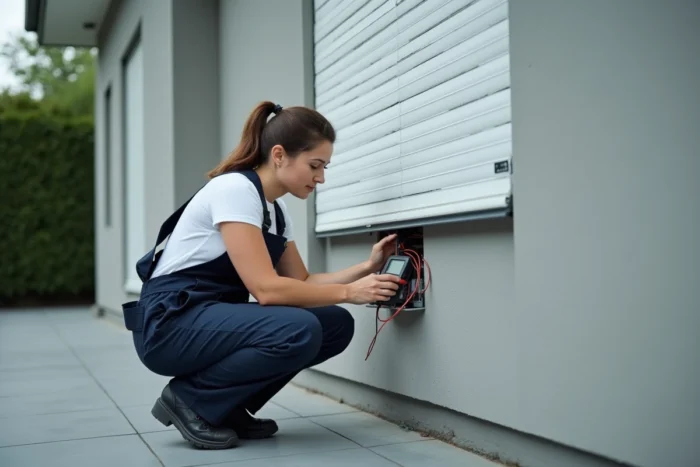
If the motor no longer reacts at all (no noise, no vibration), we check the voltage at the terminals with a multimeter. No voltage: the problem is upstream (wiring, circuit breaker). Voltage present but motor silent: the motor is out of service and needs to be replaced.
Connected roller shutter that won’t rise: consider home automation
In recent installations with centralized control (Somfy, for example), a shutter that refuses to rise while others work may not necessarily have a mechanical problem. Repair technicians are increasingly encountering cases where a poorly configured home automation scenario blocks a single shutter.
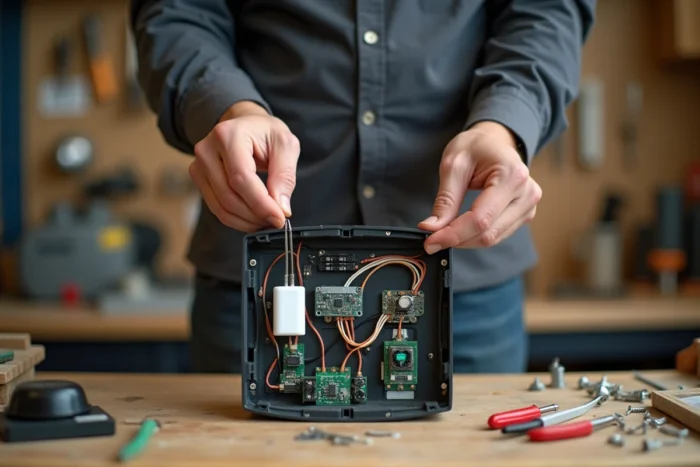
A firmware update of the home automation hub, a loss of radio connection between the motor and the central unit, or a centralization command that has desynchronized is enough to cause the blockage. We check in the app if the shutter responds to an individual command (outside of the scenario). If so, the problem comes from the programming, not the hardware.
Resetting the radio motor (double power cut for a few seconds, the procedure varies by manufacturer) often restores the connection. Feedback on this point varies depending on the models and generations of motors.
NF C 15-100 standard: what changes for the roller shutter circuit
When the repair involves touching the power supply circuit (replacing the motor, adding a dedicated line, modifying the panel), the revision of the NF C 15-100 standard from August 2024 applies. In practical terms, any work affecting the electrical circuit of the shutters must comply with this updated version: differential protections, sizing of conductors, organization of the panel.
For a simple motor replacement on an existing compliant circuit, no mandatory upgrade. However, if the panel is old and we add a motorization to a previously manual shutter, an electrician will need to check the circuit’s compliance. This point is often overlooked during DIY repairs and can pose problems during an inspection or resale.
A stuck electric roller shutter in the down position is not a fatality. Most failures are resolved by inspecting the box, cleaning the tracks, or a simple electrical reset. Keeping in mind the order of diagnosis (mechanical, then electrical, then home automation) prevents replacing a motor when a misaligned slat or a tired capacitor was enough to explain the blockage.