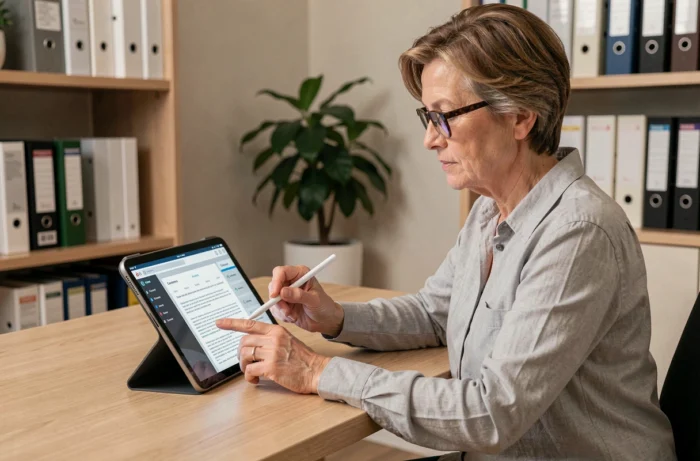
My Proxima is not software that you install on your phone or computer. It is a web portal published by Tutelle Au Quotidien, accessible from a browser at the address monproxima.fr. For families facing a guardianship or curatorship measure, this distinction changes everything: there is no file to download, no application on Google Play or the App Store.
My Proxima and the confusion with a traditional mobile application
The search “download My Proxima” regularly appears in search engines. It reflects a logical reflex: when managing the protection of an adult, one expects to find a dedicated application. The problem is that this reflex exposes users to real risks.
My Proxima operates in SaaS mode (software accessible online). No .exe or .apk file is distributed by the publisher. Updates are done server-side, without user intervention. If a site offers a file to download under the name “Proxima” or “My Proxima,” it is not the official service.
The only reliable entry point remains the direct entry of the URL monproxima.fr in the browser’s address bar, or the use of the dedicated login page (/login). A detailed guide allows you to download the My Proxima application on Magazine Seniors by clarifying each step of this secure login procedure.
Creating a shortcut on a computer’s desktop or on a tablet’s home screen gives the appearance of an installed application, without ever going through a store. This is often the most practical solution for a protected adult or a family caregiver who is not comfortable with digital tools.

Access to the My Proxima portal: the judicial representative decides
One point that families sometimes discover late: access to My Proxima depends entirely on the judicial representative (MJPM) or the guardianship service in charge of the protection measure. It is the representative who opens the file on the Proxima business software and then transmits the login credentials for the portal.
Without this prior activation, the platform remains inaccessible. Even knowing the URL, it is impossible to create an account independently.
Governance of access rights in guardianship
The representative retains control over permissions. They decide which relatives or protected individuals can view which information. This rights architecture responds to a legal logic: in guardianship, the representative acts under the control of the guardianship judge, and the dissemination of personal data of the protected adult is subject to strict rules.
In practice, an authorized family caregiver accesses a consultative space. They can view documents, monitor account status, or check deadlines. However, no accounting entry or banking operation can be performed from My Proxima. The portal is a reading tool, not an active management tool.
- The opening of access is initiated by the judicial representative, never by the family alone
- Authorized relatives have a separate access, limited to viewing data shared by the MJPM
- The representative can restrict or expand rights at any time, without systematic external validation
Connection security to My Proxima: concrete checks
The name “Proxima” is generic enough to cause confusion. Phone scams using similar names have been documented in other digital contexts. For an often vulnerable audience, a few reflexes can reduce risks.
Checks before each session
- Ensure that the URL in the address bar starts with “monproxima.fr” and that the HTTPS lock is visible
- Never click on a link received by email or SMS claiming to be from My Proxima without verifying the sender’s address
- Avoid saving the password on a shared device in a nursing home or day care
- Prefer an up-to-date browser (Chrome, Firefox, Safari) to benefit from the latest security patches
Phishing remains the main risk for senior users. An email mimicking the My Proxima interface and asking to “update your credentials” is a classic scenario. The judicial representative will never ask for a password via email.

Limitations of the My Proxima portal for daily guardianship monitoring
My Proxima meets a need for transparency between the representative and the relatives of the protected adult. Feedback from the field varies on this point: some families find the tool sufficient for monitoring day-to-day management, while others regret the lack of interactive functions.
The portal does not allow sending a message to the representative, contesting an expense, or initiating a request to the judge. It is a space for consulting data fed by the Proxima business software, not a dialogue interface.
For families wishing to go further in monitoring the protection measure, communication remains traditional: mail, phone, or meetings with the MJPM. The portal does not replace the direct relationship with the representative, nor does it cover the preparation of management accounts intended for the guardianship judge.
This functional limitation partly explains why some representatives do not systematically activate access for relatives. The tool is only valuable if the representative regularly updates the data on the business software side. An open portal but not updated creates more frustration than transparency.
For families supporting a relative under guardianship or curatorship, the first step remains to contact the judicial representative to verify if My Proxima access is available and relevant to their situation. The platform is not downloaded: it is obtained.