
An electric hedge trimmer operates by shearing: two oscillating toothed blades move in opposite directions to cut the branches caught between their teeth. The electric motor, either corded or battery-powered, drives this reciprocating motion. Choosing the right model involves balancing cutting power, battery life, weight, and blade length based on the hedge that needs maintenance.
Battery ecosystem: the criterion not shown in the technical sheet
Most guides compare electric hedge trimmers model by model. This approach overlooks a crucial factor for long-term budgeting: battery compatibility between garden tools.
Several manufacturers offer platforms where the same battery powers the lawn mower, blower, chainsaw, and hedge trimmer. The Power X-Change, One+, and Bosch 18 V systems operate on this principle. Buying a battery-powered hedge trimmer without checking if the brand matches the tools already owned leads either to multiple chargers or to purchasing incompatible batteries.
Before consulting a comparison, it’s essential to list the battery tools already present in the garage. If the brand offers a hedge trimmer within the same ecosystem, the acquisition cost decreases since the “without battery or charger” pack (often referred to as “solo”) is sufficient. The descriptions available on taille-haie-electrique.com allow for quick verification of compatibility between platforms and models.
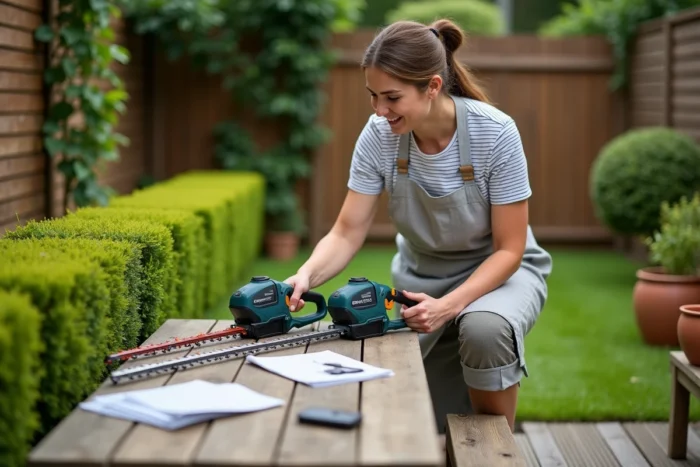
Cutting power and spacing of the teeth of an electric hedge trimmer
The cutting capacity depends on two elements that work together: the motor power and the spacing between the blade teeth.
The spacing of the teeth determines the maximum diameter of branches that the device can cleanly cut. A narrow spacing is suitable for hedges of privet, boxwood, or cherry laurel, where the branches remain thin. A wider spacing accommodates woody branches, typical of country hedges or hornbeam hedges left untrimmed for several seasons.
The motor power, expressed in watts for corded models or volts for battery models, conditions the oscillation speed of the blades. An undersized motor facing overly thick branches causes jams, torn cuts, and premature wear of the blades.
How to assess the real need
Measuring the diameter of the thickest branches of the hedge provides a reliable indication. If most of the branches exceed the typical diameter of an entry-level hedge trimmer, a lopper or pruner is necessary for the thick wood before using the hedge trimmer on the foliage.
Blade length and ergonomics: adapting the tool to the hedge
The blade length directly influences the cutting width per pass and the weight of the device. A long blade covers more surface but adds weight to the tool and complicates precise vertical cuts.
- Short blades (around 45 cm) are maneuverable, suitable for small hedges, topiaries, and isolated shrubs. They allow for sculpting work that is difficult to achieve with a long blade.
- Medium-length blades (50 to 55 cm) offer a compromise between efficiency and control, sufficient for most residential hedges.
- Long blades (60 cm and more) reduce the number of passes on extensive hedges, but their weight makes work tiring after a few dozen minutes.
The total weight of the device (including the battery for cordless models) determines the comfortable working duration. Trimming a hedge at height, with arms extended, strains the shoulders and wrists. A lightweight model with a medium blade tires less than a powerful but heavy model used overhead.
Telescopic hedge trimmer for tall hedges
For hedges that exceed shoulder height, a telescopic hedge trimmer (on a pole) avoids the need for a step ladder. The adjustable cutting head allows for trimming the top of the hedge from the ground. The safety gain is real: working at height with a cutting tool on an unstable ladder remains the leading cause of accidents when trimming hedges.
Corded or battery: actual autonomy and usage constraints
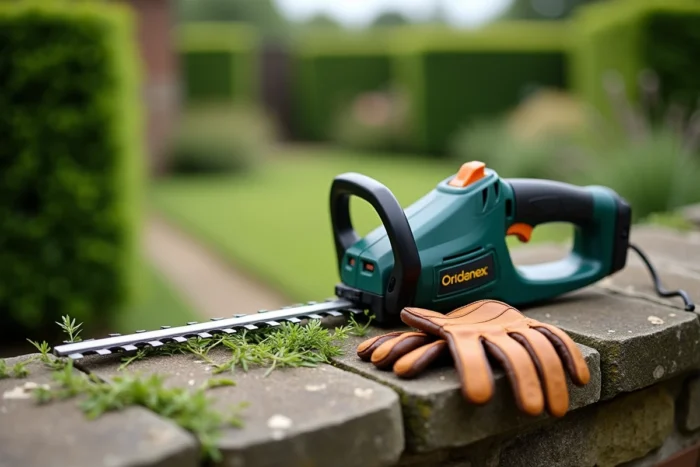
The corded electric hedge trimmer is cheaper to purchase and does not experience any power drop during use. Its limitation is physical: the electric extension restricts the range of action and gets caught in branches on the ground.
The battery model frees up movement. User feedback indicates an autonomy of about one and a half hours at maximum speed with a high-capacity battery, which is sufficient for most residential gardens. Having a second charged battery eliminates the risk of running out of power in the middle of trimming.
- Small garden with accessible power outlet: the corded option remains the most economical and lightweight choice.
- Large garden or hedge far from the house: the battery avoids unrolling dozens of meters of extension cord.
- Professional use or existing tool park: the battery compatible with the already owned ecosystem reduces overall cost.
The gas-powered option, once the reference for dense hedges, is losing ground to battery-powered models, even among landscaping professionals, for reasons of noise, emissions, and daily comfort of use.
Blade maintenance and lifespan of the hedge trimmer
Poorly maintained blades tear wood instead of cutting it, which weakens the hedge and promotes fungal diseases. After each use, wiping the plant resin with a cloth soaked in alcohol or resinous product prolongs the sharpness.
Sharpening the blades once or twice per season with a flat file maintains cutting quality. Regularly checking the condition of the teeth allows for spotting a bent or chipped tooth before it damages the entire blade.
For battery models, storing the battery at room temperature and avoiding letting it discharge completely preserves its capacity over several seasons. An electric hedge trimmer with properly maintained blades and battery remains operational for many years, which puts the initial price gap with a more frequently replaced entry-level model into perspective.