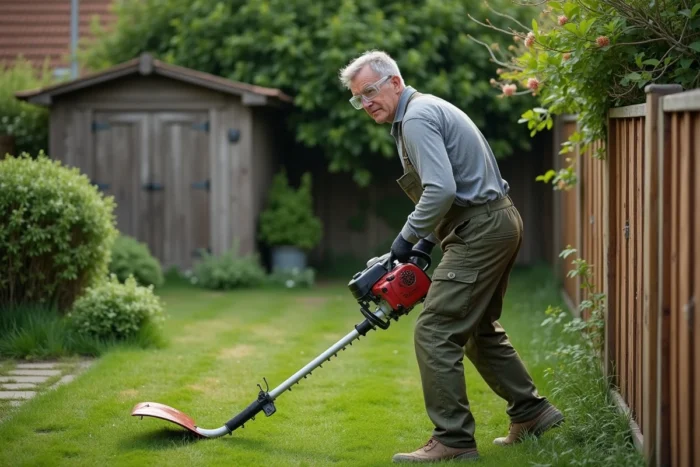
Your yard starts to look like a wasteland as soon as you turn your back for two weeks. The mower struggles on the tall grass, and the trimmer only tickles the brambles. This is a sign that it’s time to switch to a brush cutter, but not just any model. Choosing one that suits your garden helps avoid overspending, unnecessary fatigue, or putting the device away after just twenty minutes.
Noise and local regulations: a selection criterion often overlooked
Before even talking about the engine or blade, ask yourself a simple question: what time do you plan to work? Some French municipalities tighten the allowed working hours for motorized gardening equipment to protect the tranquility of residents. A powerful gas model becomes unusable on Sunday mornings if your municipal decree prohibits it.
This factor guides the choice towards one type of motorization over another. Battery-powered brush cutters are significantly quieter than gas ones. For a garden in a densely populated residential area, a battery model avoids neighborly conflicts and offers scheduling flexibility that gas models no longer allow.
Check with your town hall: restrictions vary from one municipality to another. This regulatory detail alone can sway your decision. References for brush cutters suitable for different contexts can be found on debroussailleuse-warrior.com, allowing you to compare noise levels before purchase.
Brush cutter motorization: gas, battery, or corded
You may have already noticed that the same word, “brush cutter,” covers very different machines? The engine determines the weight, autonomy, maintenance, and the type of vegetation you can tackle.
Gas brush cutter: brute force
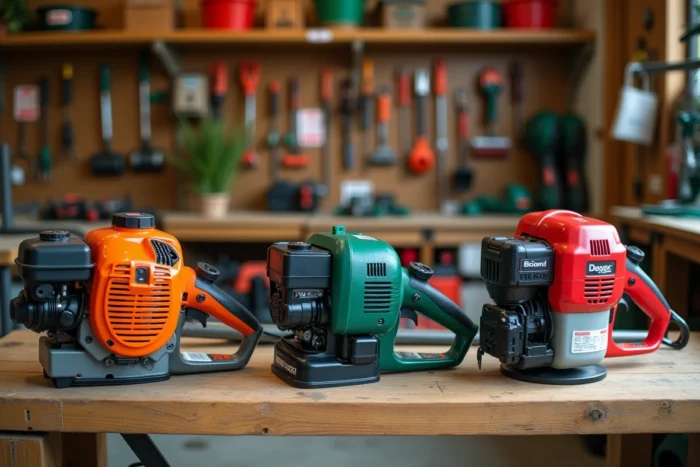
The gas engine (two-stroke or four-stroke) delivers the highest power. It’s the logical choice for clearing an abandoned lot, cutting thick brambles, or working on large areas without autonomy constraints. The downside: the weight and noise are significantly higher. Maintenance (spark plug, filter, oil-gas mixture) requires a minimum of diligence.
Battery brush cutter: the evolving compromise
Wireless models are favored for their lightness and maneuverability, especially on sloped terrain. In recent years, the rise of lithium-ion batteries has made these machines capable of handling tall grass and semi-dense vegetation. However, their autonomy remains limited compared to gas models. For a medium-sized garden, one or two batteries are usually enough to complete the session.
Corded electric brush cutter: the minimal budget
Plugged into an outlet, it never runs out of battery. Its power remains modest, suitable for finishing touches and small areas close to the house. The cord obviously limits the range. If your yard exceeds a few hundred square meters or has areas far from an outlet, this is not the right choice.
Cutting system: nylon line or blade, depending on the vegetation
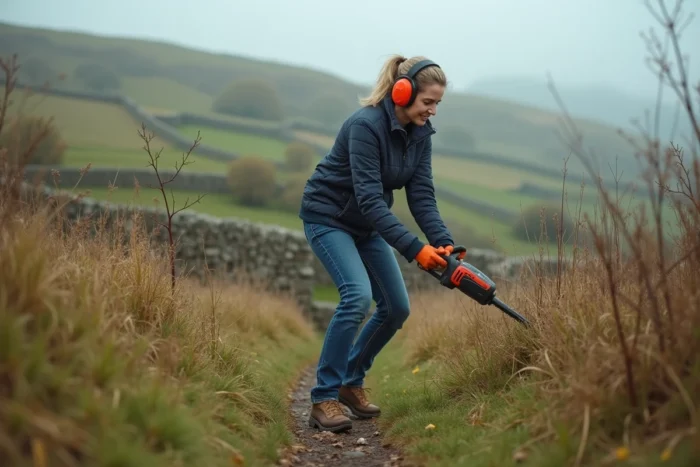
The engine powers the machine, but it’s the cutting tool that does the work. Why does this choice matter so much? Because a nylon line on brambles two centimeters in diameter will break every thirty seconds. And a metal blade on a grass edge will scalp the lawn.
- Nylon line: suitable for soft grasses, tall grasses, and edging finishes. Light, inexpensive to replace, it wears out quickly on woody vegetation.
- Plastic blade: a step up from the line, it cuts semi-dense grasses but does not withstand woody stems. Often provided with entry-level battery models.
- Metal blade (2, 3, or 4 teeth): designed for brambles, dense underbrush, and even young shrubs. It requires a sufficiently powerful engine and a safety harness.
- Grass or brush disc: reserved for professional gas brush cutters. Capable of cutting stems several centimeters in diameter.
Most brush cutters accept several types of cutting tools. Check compatibility before purchase: a versatile line and blade model covers most needs of a mixed garden (lawn, slope, semi-wild area).
Weight, ergonomics, and comfort of use in the garden
A criterion that technical sheets often relegated to the bottom of the page, but that your shoulders will feel after the first half hour. The weight of a brush cutter varies greatly depending on the motorization.
Entry-level battery models are the lightest. Backpack gas models distribute the weight across the back and hips, relieving the arms. In between, portable gas models concentrate all the weight on one arm, via a single or double harness.
Here are a few points to check in-store or on the product sheet:
- The type of harness: single shoulder for light models, double harness with hip protection for heavy machines.
- The handle: bicycle-style handlebar for large flat areas, loop handle for areas requiring maneuverability on slopes.
- The anti-vibration system, which reduces fatigue during prolonged sessions. Its absence can be costly after an hour of work.
Why emphasize this point? Because a machine that is too heavy or poorly balanced ends up stored in the garage. The best engine in the world is useless if you can’t hold it for thirty minutes.
Brush cutter and garden maintenance: adapting the tool to the terrain
A small urban garden with a few borders and a slope does not have the same requirements as a countryside lot bordered by hedges and brambles. Rather than searching for “the best brush cutter” in absolute terms, identify your situation.
For a modest-sized garden, mainly consisting of grass and a few borders, a battery trimmer is sufficient. It’s the lightest, quietest tool, and it costs the least to purchase and use.
For a medium-sized lot with varied vegetation (tall grasses, some brambles, a slope), a battery brush cutter with a line and blade kit offers the best compromise. It covers most situations without the hassle of mixing gas or the noise of a gas engine.
For a large lot or intensive clearing (wasteland, underbrush, established brambles), gas remains the reference. Its power and unlimited autonomy make it suitable for heavy work, provided you accept the weight and mechanical maintenance that come with it.
The right choice of brush cutter depends on three concrete elements: the vegetation to cut, the area to cover, and the time you are willing to spend with the machine in hand. Start from your terrain, not from a marketing sheet.