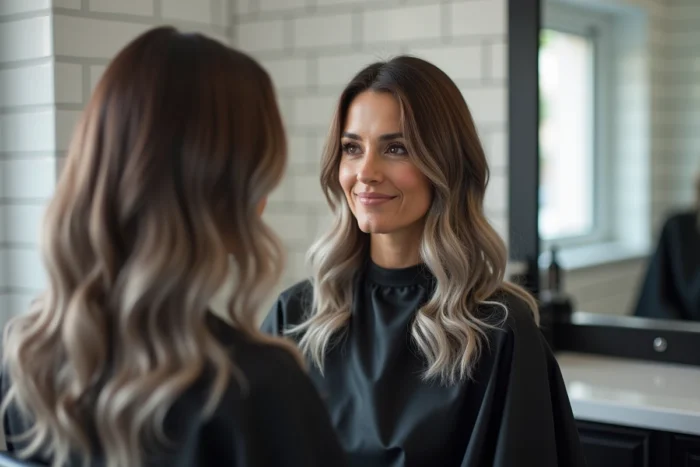
When coloring brown hair for years, the first centimeters of white regrowth create a stark contrast that grey blending is supposed to soften. On a dark base, the promise of a natural blend between white roots and brown lengths faces a technical reality. The tonal distance between pure white and deep brown requires more demanding bleaching work and follow-up that many salons underestimate.
Intermediate toning on brown hair: the appointment that no one mentions
Grey blending is often talked about as a liberation from classic coloring. Fewer salon visits, less visible roots, more peace of mind. On a blonde or light brown base, this is partly true. On a brown base, the reality on the ground changes.
Lightened strands on brown hair tend to turn warm (coppery, golden) over time with shampoos. To maintain a result consistent with the sought-after salt-and-pepper effect, a cool toning between balayage sessions becomes almost essential. This intermediate appointment, often scheduled every six to eight weeks, serves to neutralize yellowing and maintain the consistency of cool tones throughout the hair.
Several colorists remind us that grey blending on a brown base is not a return to natural without constraints, but rather a new hair routine, different from covering color, not necessarily lighter. Many grey blending ideas for brown hair confirm this requirement for specific follow-up for dark bases.

Controlled bleaching on a brown base: the limits to know before starting
On dark brown hair, achieving a sufficient level of bleaching to create silver-grey or ash-blonde strands requires several steps. The hair fiber undergoes real mechanical and chemical stress, and the result directly depends on the color history.
Henna and metallic dyes: a major technical hindrance
Hair that has been treated with henna or with dyes containing metallic salts poses a serious problem. Bleaching on henna can cause unpredictable reactions, ranging from greening to outright breakage of the fiber. A prior hair diagnosis in the salon can identify these cases, but not all hairdressers perform this test systematically.
When the hair history is loaded (successive colorings, straightening, henna), the feedback varies on this point, but caution is to spread the process over several sessions rather than forcing the bleaching in one go.
Choosing between cool and warm tones: a technical decision
The choice between ashy (grey, silver, polar blonde) and warmer (beige, champagne) tones is not just a matter of taste. On a brown base, cool tones require more extensive bleaching and more frequent toning maintenance. Warm tones are easier to achieve and maintain, but they stray from the natural grey effect.
- Ashy or silver tones: significant bleaching, regular cool toning, very bright result but sustained maintenance
- Beige or champagne tones: moderate bleaching, less risk of yellowing, softer blend with brown lengths
- Face-framing placement (strands framing the face): concentrates the bright effect where it is most visible, limits the bleached area and thus the damage to the overall hair
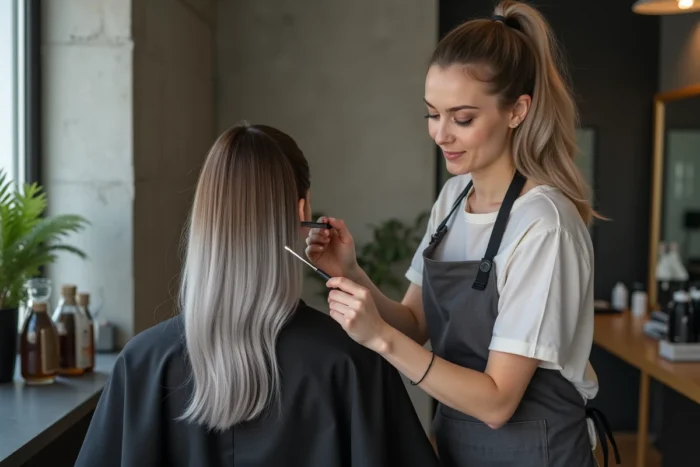
Targeted care after grey blending: protecting the bleached fiber in the long term
Once the balayage is done, the quality of the result depends as much on daily care as on the technical gesture in the salon. Lightened strands on brown hair are inherently more porous than the rest of the hair, and this difference in porosity creates areas that absorb pigments unevenly.
A purple shampoo used once or twice a week neutralizes yellow tones on the lightened strands without altering the brown base. It should be left on for a few minutes before rinsing, no more, to avoid dulling the dark lengths.
The essential treatments on the ground:
- A weekly hydrating mask to compensate for the dryness related to bleaching, applied only to the lengths and ends
- A thermo-protective treatment before each blow-dry or flat iron, as heat accelerates the shift of cool tones towards gold
- A gloss in the salon every two to three months to revive shine and correct the tonal discrepancies between roots and lengths
Grey blending and short brown hair: a game-changing format
On a bob or short cut, grey blending takes on a different dimension. The regrowth is more quickly visible, which may seem constraining. In practice, it’s the opposite: the blend between white roots and worked strands is more noticeable on short hair, giving a more pronounced salt-and-pepper effect sooner than one might think.
The placement of the strands requires increased precision. On a short cut, every strand counts and poor placement creates an immediately visible imbalance. Colorists who master grey blending on short hair often work strand by strand with a fine brush rather than a classic balayage comb.
The touch-up rhythm also adapts: with a regularly refreshed short cut, the demarcation area remains minimal, and salon visits for color can be spaced out more than on long hair.
Grey blending on brown hair remains a demanding technique that requires a true initial diagnosis and follow-up tailored to the specifics of dark bases. The most natural result is achieved by accepting that the transition takes several sessions, not by forcing the process during a single visit. It is this patience that makes the difference between a successful blend and a bleaching gone wrong.