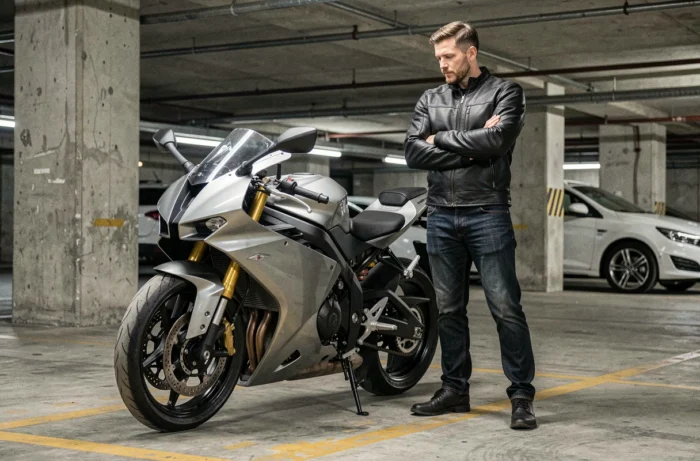
The Yamaha YZF-R1 has long represented the pinnacle of the Japanese sports bike lineup on the road. With the end of its road homologation related to the Euro5+ standard, riders who used the R1 daily or on the track now face a concrete choice: which bike to turn to in order to regain comparable sensations?
Why the R1 is leaving the road and what Yamaha is preparing behind the scenes
The Euro5+ standard imposes emission thresholds that the R1’s crossplane engine no longer meets in its current configuration. Yamaha has chosen not to adapt this engine for road homologation and to redirect the R1 towards exclusive track use, in the form of a Race version.
Before looking elsewhere, it’s important to know that several recent sources indicate that Yamaha Motor Europe has reopened the road homologation file for a potential return of the R1. Nothing is confirmed in terms of timing, but this changes the nature of the issue: we might be talking about a temporary transition rather than a definitive farewell.
In the meantime, Yamaha is restructuring its sports lineup around two complementary models. The brand is relying on the R7/R9 duo to cover the road and sport uses that the R1 previously handled alone. Exploring the replacement options for the R1 therefore requires understanding this new lineup architecture.
Yamaha R9: the designated road successor to the R1
The R9 is the model that Yamaha positions as the direct heir to the R1 for sport-road use. It is not just an additional intermediate displacement added to the catalog. The R9 takes on the role of a versatile sports bike that the R1 occupied for riders who ride both on the road and during track days.
Its three-cylinder engine, derived from the MT-09 platform, offers a different character compared to the four-cylinder crossplane. The torque arrives lower in the rev range, making the bike more usable on open roads. For a former R1 owner who used their bike daily, this change in engine philosophy is a point to consider: the R9 does not aim to replicate the rev range of a 1000cc four-cylinder; it offers something different.
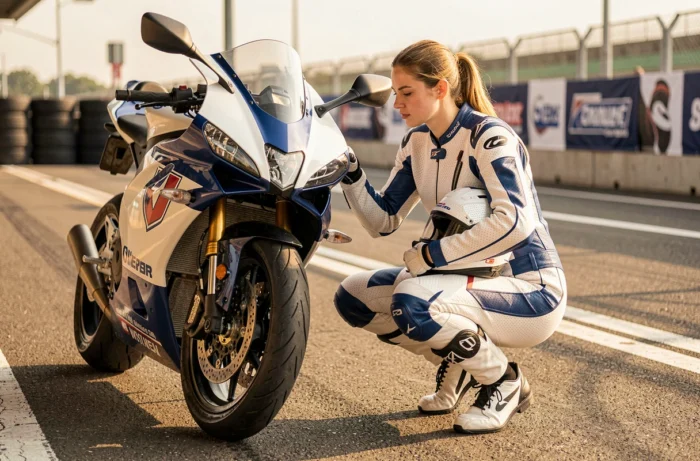
Did you primarily ride the R1 on the track? The R9 remains relevant for track days, but it does not replace the raw power of a liter-class bike. It is aimed more at the rider who wants a modern, road-legal sports bike capable of doing everything well.
Yamaha R7 with electronics inherited from the R1: an underestimated surprise
The R7 was perceived at its launch as an entry-level sports bike, accessible and lightweight, but without pretensions against larger displacements. Recent developments change the game. The R7 now inherits part of the R1’s electronics, particularly in terms of traction control management and riding modes.
This upgrade in electronics transforms the R7 into a realistic replacement solution for some of the uses that the R1 covered. Not all, of course. The power remains that of a medium-displacement twin-cylinder. However, on the following points, the 2024 R7 comes closer to what the R1 offered:
- Electronic riding aids comparable in fine-tuning, with maps derived from the R1
- Light and agile chassis, which is more forgiving on the track than a nervous liter-class bike
- Maintenance and consumable costs (tires, brake pads) significantly lower than those of a hypersport bike
For a rider who did a few track days a year with their R1 without aiming for competition, the R7 offers a pleasure/budget ratio that is hard to beat.
Alternatives outside the Yamaha range: what deserves a test ride
Staying loyal to Yamaha is not a requirement. The segment of road-legal sports bikes has evolved, and some competitors deserve attention.
The Aprilia RSV4, for example, has moved to a slightly larger displacement in recent years. Its V4 remains one of the most expressive engines on the market. For an R1 rider used to a characterful four-cylinder, the transition is not too much of a mechanical upheaval.
At Ducati, the Panigale V4 represents the benchmark in terms of onboard technology. Its price and maintenance costs are higher, but Ducati’s electronics set the standard for the segment in terms of customization of riding aids.
Kawasaki keeps the ZX-10R in its catalog with road homologation. It shares with the R1 a philosophy of a four-cylinder inline focused on pure performance. It is probably the most natural transition for those seeking similar mechanical sensations.
Criteria to compare before choosing
- Main use: daily road, sport-touring, occasional track days, or amateur competition
- Total budget including insurance, consumables, and maintenance over three years
- Availability of parts and nearby dealer network
- Ergonomics and riding position, often overlooked during an impulse purchase

Used R1 or R1 Race: two options for the die-hards
Some riders simply do not want to move on. In this case, two options exist. The used market still offers recent R1s in good condition. A well-maintained used R1 remains road-legal as long as its registration certificate is valid. The end of production does not invalidate existing registration documents.
The other option is the R1 Race, reserved for track use. It retains the crossplane engine in its most advanced configuration, without the homologation constraints. For those who ride exclusively on the track, it is the direct continuation.
The choice ultimately depends on the role that the road plays in your riding. Yamaha’s strategy with the R7/R9 duo covers the majority of profiles, and a potential return of the road-legal R1 could reshape the landscape in the coming years.