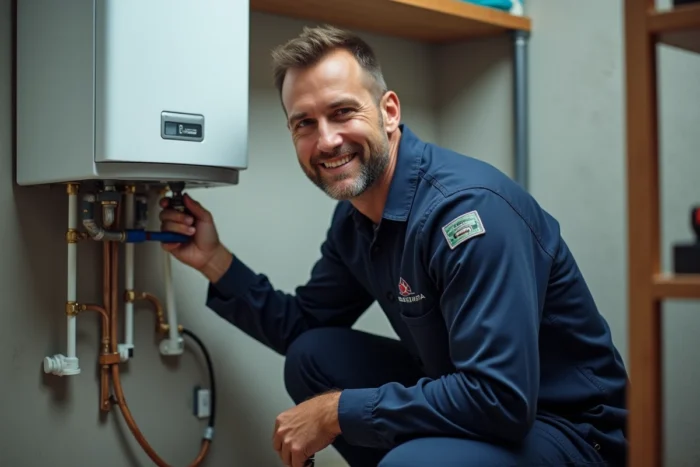
Between descaling the hot water tank and replacing a faulty safety group, the boundary between what falls to the tenant and what is the responsibility of the owner remains unclear for many occupants and landlords. The answer depends on the type of device installed in the housing, the nature of the intervention, and, above all, each party’s ability to prove that maintenance has indeed been carried out.
Distribution of maintenance costs for the water heater: comparative table by energy type
| Type of water heater | Regular maintenance (tenant) | Mandatory annual maintenance | Major repairs / replacement |
|---|---|---|---|
| Electric (storage tank) | Flushing, cleaning the heating element, replacing small parts (seals, safety group) | Not legally mandatory | Owner (obsolescence, normal wear) |
| Gas | Replacing membranes, valves, seals, piezoelectric ignition | Yes, by a professional, at the tenant’s expense | Owner (obsolescence, normal wear) |
| Solar | Cleaning accessible sensors, visual inspection | According to manufacturer recommendations | Owner |
This table summarizes the general logic established by decree no. 87-712 of August 26, 1987, which lists the repairs for which the tenant is responsible, and by the law of July 6, 1989, whose articles 6 and 7 distribute obligations between landlord and occupant. The question of water heater maintenance in rental properties is therefore first resolved by identifying the energy used by the device.
The clearest distinction concerns gas. The decree of September 15, 2009, imposes a mandatory annual maintenance by a qualified professional for any gas-operated device. The tenant must cover this visit and keep the certificate provided by the technician. For electric water heaters, there is no legal obligation for annual maintenance, which does not exempt the tenant from regular maintenance (flushing, cleaning).

Water heater breakdown in rental: obsolescence or lack of maintenance
When a hot water tank breaks down, the question is not just “who pays?” but “what is the cause of the malfunction?”. The answer directly affects financial responsibility.
If the breakdown results from obsolescence or normal wear of the device, the replacement falls to the owner. A storage tank that has exceeded its lifespan and whose tank is corroded falls into this category. The landlord cannot charge this type of intervention to the tenant.
On the other hand, if a professional finds that the breakdown is due to a lack of maintenance (scale accumulated over years on the heating element, safety group never purged), the tenant may be held responsible for the repairs. This distinction, established by the law of July 6, 1989, fuels the majority of disputes between occupants and landlords.
Common wear parts remain the tenant’s responsibility
The 1987 decree precisely lists the interventions considered as tenant repairs for a gas device:
- Replacement of bimetals, pistons, membranes, and water boxes
- Replacement of valves and sealing gaskets
- Replacement of the piezoelectric ignition
- Flushing and cleaning of heating bodies and pipes
For an electric water heater, the tenant is responsible for descaling, replacing the flange gasket, and periodically draining the safety group. Anything beyond regular maintenance (replacement of the armored heating element, changing the faulty thermostat due to long-term wear) is more difficult to assign without a technical diagnosis.
Proving water heater maintenance without an invoice: the blind spot of disputes
Most articles on the subject explain who should pay for what. Few address what happens when neither party can prove that maintenance has been done or neglected. It is precisely here that conflicts crystallize.
Why the invoice changes everything
In the event of a dispute brought before a departmental conciliation commission or a court, the burden of proof lies with the one who claims to have fulfilled their obligations. A tenant who claims to have maintained the hot water tank but has no professional invoice or even a receipt for purchased parts finds themselves in a weak position.
For gas water heaters, the annual maintenance certificate is the most compelling piece of evidence. The owner can request it every year, and its absence at the exit inventory may justify a deduction from the security deposit if the device shows damage.
What tenants and owners should keep
- Tenant: annual maintenance certificates (gas), descaling invoices, purchase receipts for parts (seals, safety group), dated photos of the device upon moving in
- Owner: purchase or installation invoice for the water heater (to establish its age), last maintenance invoice before renting, entry inventory detailing the condition of the tank
- Both parties: copy of any written exchange (email, letter) mentioning a request for intervention or a report of a breakdown
Without these documents, an owner will struggle to prove that the breakdown is due to a lack of maintenance by the tenant. Conversely, a tenant will not be able to demonstrate that the device was already obsolete upon their arrival if the entry inventory remains vague on the subject.

Electric or gas water heater in rental: what changes for the tenant
The lack of a legal obligation for annual maintenance for electric water heaters creates a blind spot. The tenant is not required to have a professional intervene every year, but regular maintenance remains the only protection in case of a dispute. Having the storage tank descaled every two to three years in an area with hard water, for example, provides an invoice that documents the proper use of the device.
For gas, the situation is more regulated. A tenant who does not carry out the annual maintenance faces a double consequence: a potential deduction from the security deposit and being held responsible if a breakdown occurs. The owner, for their part, must provide a device in good working order upon entering the property, in accordance with article 6 of the law of July 6, 1989.
The key point that resolves most disagreements is neither the type of energy nor the amount of the repair, but the existence or absence of a document certifying maintenance. Keeping every invoice, every certificate, and every written exchange with the landlord or tenant remains the only reliable way to protect one’s interests when the responsibility for the breakdown is in question.