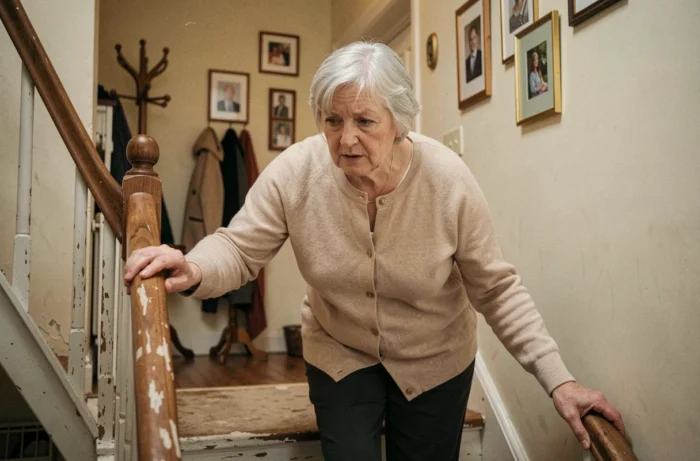
A 78-year-old person gets up at night to go to the bathroom, catches the edge of a poorly secured rug, and ends up on the floor. This seemingly mundane scenario leads to over 100,000 hospitalizations each year in France.
Falls among the elderly are not just simple household accidents: they represent the leading cause of loss of autonomy after the age of 65. Their frequency has significantly increased in recent years despite the preventive measures that have been put in place.
The national fall prevention plan has not curbed the rise in hospitalizations
The government launched a three-year national fall prevention plan in 2022, with a stated goal of reducing fatal or disabling falls by 20% by 2024. On the ground, the results are quite different.
According to the Public Health France bulletin on data from 2015-2024, hospitalizations related to falls among those aged 65 and older have markedly increased between 2019 and 2024. The gap between political ambition and reality is striking: instead of decreasing, deaths and hospital stays related to falls have risen during this period.
One can find health information on The Health Portal that details the mechanisms at play. The observation remains the same: demographic aging is outpacing the adaptation of housing and care pathways.
This discrepancy is partly explained by the lack of early detection. The High Authority of Health (HAS) validated a standardized fall risk detection form in March 2024 for primary care, based on three simple questions asked by the treating physician: has the person fallen in the last twelve months, does she feel unstable, is she afraid of falling? This three-question screening remains poorly applied in general practice.
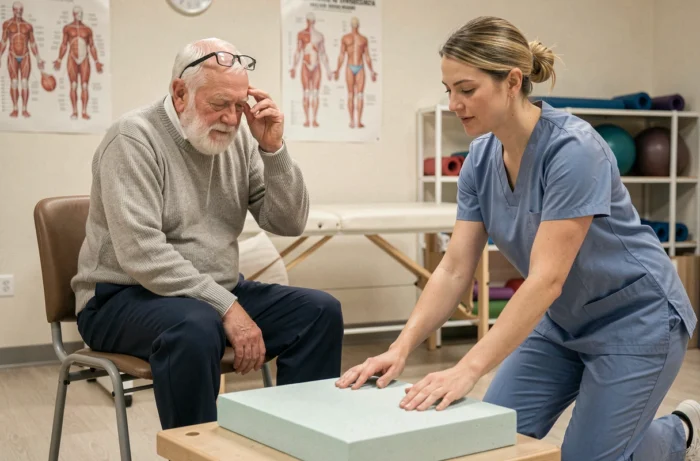
Fall risk factors in the elderly: beyond age
The problem is often reduced to “elderly people lose their balance.” The reality is more complex. Falls almost always result from a combination of factors, rarely from a single cause.
Physical and medication-related factors
Muscle mass loss (sarcopenia) accelerates after age 70 and reduces the ability to recover from a loss of balance. Vision problems, particularly macular degeneration and untreated cataracts, distort the perception of obstacles. Hearing loss, often underdiagnosed, also degrades spatial balance.
Psychotropic medications multiply the risk of falls. Benzodiazepines, antidepressants, antipsychotics: their accumulation in a poly-medicated patient causes drowsiness, dizziness, and orthostatic hypotension. A regular medication review with the treating physician or pharmacist is one of the most concrete prevention levers.
The home environment as a daily trap
The majority of falls occur at home during routine actions. The most at-risk areas are well known:
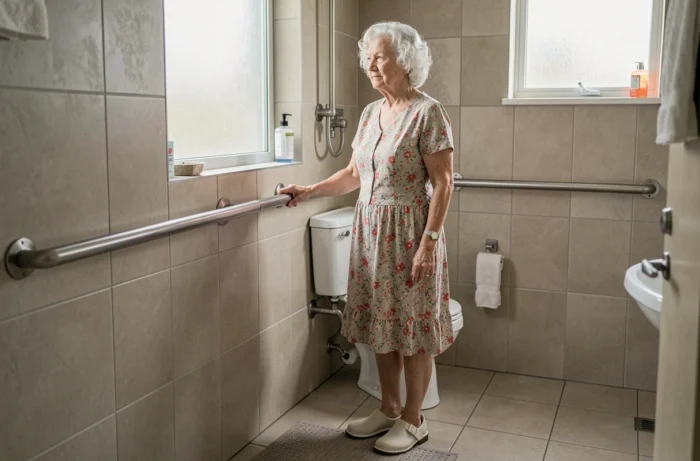
- The bathroom, where the wet floor and lack of grab bars make every shower risky, especially in the morning when blood pressure is still low.
- Stairs, especially when lighting is insufficient or the railing is unstable. A step with a worn edge becomes invisible at night.
- The bedroom, with electrical cords on the floor, unsecured rugs, and the nighttime journey to the bathroom in the dark.
The impact of shoes worn indoors is also underestimated. Slippers without heel support or socks on smooth tiles cause slips that closed shoes with non-slip soles would prevent.
Adapted physical activity: the dose that makes the difference
Fall prevention involves muscle strengthening and balance training. This is not generic advice: recent research has quantified the necessary dose.
Programs combining muscle strengthening and balance exercises significantly reduce the fall rate among those over 65, provided they are practiced regularly, at least two to three times a week. Several structured regional programs exist, such as the “Health Balance” workshops offered in some communities for the 2026-2027 period.
Feedback varies on this point, but regularity matters more than intensity. A daily walk of thirty minutes, supplemented by chair rises and single-leg support exercises, produces measurable results on postural stability within a few weeks.
Teleassistance and fall detection: what technology really changes
Teleassistance devices have diversified significantly. The classic pendant with a push button remains useful, but it assumes that the person is conscious and able to press it. However, during a fall with loss of consciousness or prolonged immobility on the ground, this is not the case.
Automatic fall detection sensors change the game. Worn on the wrist or integrated into a smartwatch, they detect impact and prolonged immobility, then trigger an alert without the person’s intervention. In nursing homes, these systems help reduce the time spent on the ground, a critical parameter: the longer the time on the ground, the worse the complications (hypothermia, rhabdomyolysis, dehydration) become.
At home, coupling a fall detector with a 24/7 teleassistance service offers additional security, especially for those living alone. The monthly cost remains moderate and can be partially covered by the APA (personalized autonomy allowance) or certain mutual insurance plans.
Early detection and coordination: two angles still neglected
The HAS form from 2024 marks a turning point in the approach to detection. Three simple questions asked during a consultation are sufficient to identify a high risk and direct towards a complete fall assessment (gait examination, visual assessment, prescription review, home evaluation).
The problem is not the tool, but its adoption. A general medicine consultation lasts on average fifteen minutes, and fall risk detection often takes a back seat to already monitored chronic conditions. Integrating these three questions into the annual assessment of patients over 65 would take little time but requires coordination between the physician, pharmacist, and occupational therapist that the healthcare system struggles to organize.
Preventing falls among the elderly is not just about installing a grab bar in the shower. It is a task that combines medical detection, housing adaptation, regular physical activity, and detection technology. The weakest link remains upstream detection, before the first serious fall.