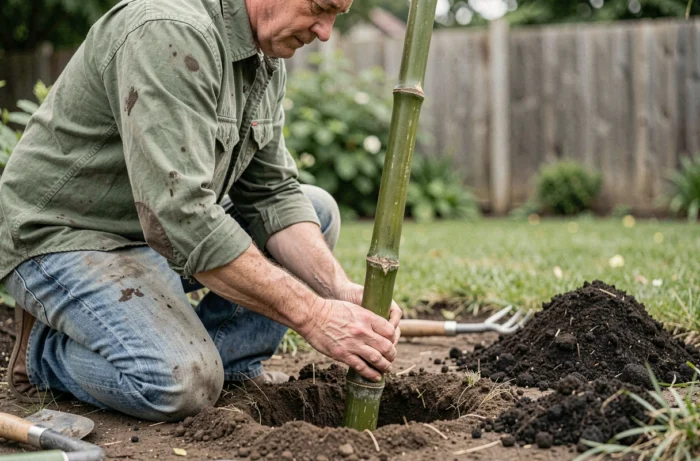
Fixing bamboo to the ground involves constraints that other materials do not present: cylindrical section, hollow wall, sensitivity to bursting under point pressure. The choice of method depends less on aesthetic preference than on the nature of the soil, the diameter of the culms, and the load that the structure must support.
This article compares the main fixing options and details the technical points that make the difference between a stable assembly and one that gives way at the first gust of wind.
Clay, sandy, or loose soil: the fixing that corresponds to each terrain
The type of soil directly determines the anchoring method. A metal stake driven into compact clay soil does not react at all like the same stake in draining sand. Recent feedback from landscapers confirms a clear differentiation based on the terrain.
| Type of soil | Recommended method | Anchoring depth | Particularity |
|---|---|---|---|
| Clay | Metal stake driven with a crowbar | Moderate | Abundant watering after installation to create a suction effect around the stake |
| Sandy | Helical anchor | Deeper than in clay | The spiral screwing compensates for the lack of cohesion in the sand |
| Loose or backfilled | Plate on concrete slab or compacted gravel footing | Variable depending on the footing | The bamboo is not in direct contact with the moist soil |
On clay soil, the trick of post-installation watering is not trivial. Water saturates the micro-spaces around the stake, and the clay shrinks around the metal as it dries. The hold obtained is significantly firmer than a simple dry insertion.
On sandy soil, helical anchors replace straight stakes advantageously because the screw creates a lateral resistance that the sand alone does not provide. A classic stake in sand can become dislodged under the effect of wind in a few weeks.
To delve deeper into the bamboo fixing techniques, the logic remains the same: adapt the anchoring to the terrain before choosing the connection system to the culm.
Drilling and fixing bamboo without cracking it: tools and diameter
The wall of bamboo is fibrous and hollow. Drilling with an unsuitable bit causes longitudinal cracks that weaken the entire structure. The choice of drilling tool is a technical point that many guides overlook.
The auger (or hole saw) is the reference tool for large diameter penetrations. It cuts a clean circle without exerting radial pressure on the wall. For bolt or threaded rod fixings, a standard wood bit works, provided two precautions are followed:
- Always drill at low speed and without excessive pressure, allowing the bit to progress on its own through the fiber
- Position the drilling as close as possible to a node (internode), where the wall is thickest and most rigid
- Place an internal support (wood plug or dense foam) inside the culm to prevent the opposite wall from bursting out as the bit exits
Drilling near a node reduces the risk of bursting because the fiber is oriented crosswise there, unlike the intermediate sections where it follows a single axis.
Fixing with a through-threaded rod
The stainless steel threaded rod, passed through two aligned drillings of the culm and then tightened with wide washers and nuts, constitutes the most resistant mechanical fixing to connect bamboo to a metal plate on the ground. The wide washers distribute the pressure on the wall and prevent the bamboo from splitting under tightening.
The diameter of the rod must remain less than one-third of the inner diameter of the culm. Beyond that, the drilling area weakens the load-bearing section too much.
Bracing and natural ties: when rope is enough to secure to the ground
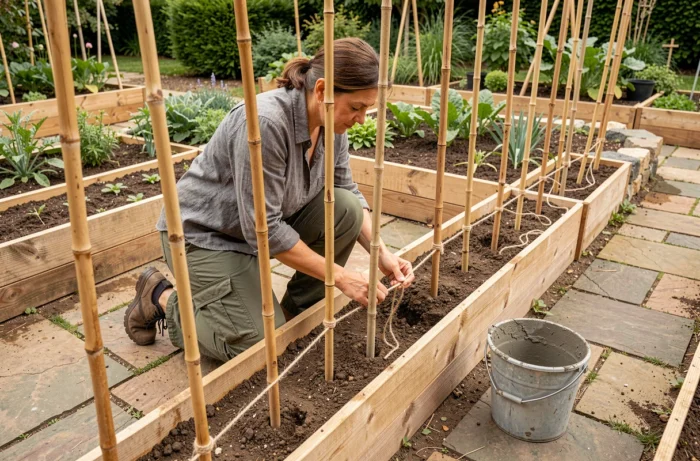
Not all installations require metal hardware. For lightweight structures (decorative fences, trellises, vertical screens), bracing with rope remains a reliable method, provided one masters the knot and the tying material.
Simple bracing consists of wrapping a rope alternately around two crossed bamboos, then tightening with perpendicular turns (the “frappings”). A well-tightened bracing supports lateral loads comparable to a bolt on small diameter culms.
The choice of rope is as important as the knot technique:
- Natural fiber rope (hemp, sisal): aesthetically consistent with bamboo, but limited lifespan when exposed outdoors
- Synthetic rope (polyester, polypropylene): significantly better resistance to UV and moisture, less natural appearance
- Plastic-coated wire: very firm tightening, suitable for fixings on buried metal stakes, but can cut into the wall if the wire diameter is too thin
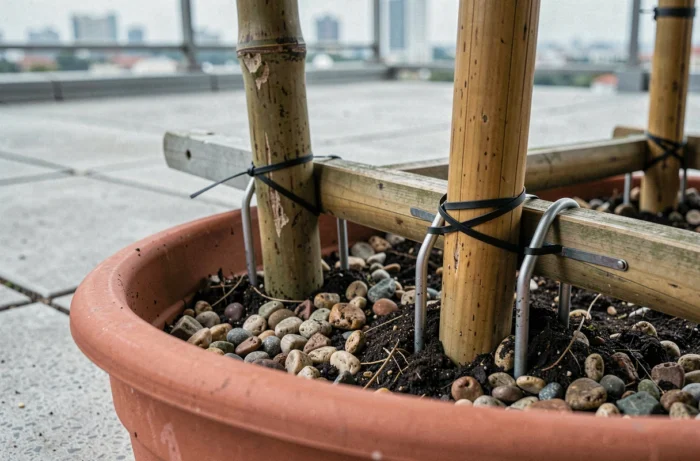
To fix bamboo to the ground by bracing, the method consists of driving a stake (treated wood or metal) and then tying the culm to the stake with crossed bracing. The stake ensures the anchoring, the bracing ensures the connection. Separating these two functions avoids stressing the bamboo itself as an anchoring element, which it does poorly due to its smooth surface.
Anti-rhizome barrier and ground fixing: two distinct problems not to be confused
Fixing cut and dry bamboo culms to the ground has nothing to do with containing living bamboo planted in the ground. Confusing the two generates costly mistakes.
For living running bamboos, the buried anti-rhizome barrier made of HDPE between 60 and 80 cm with an approximately 5 cm overhang above the ground is now the reference method. This depth and slight surface overhang are presented as a recent standardized practice, more systematic than a few years ago.
In contrast, for dry culms used in construction or decoration, the anti-rhizome barrier is of no use. The problem is purely mechanical: resisting wind, supporting weight, maintaining alignment. Steel plates, through-threaded rods, or bracing on buried stakes meet this need.
Confusing mechanical anchoring and root confinement often leads to undersizing one or the other. A well-contained living bamboo can still topple if its staking is insufficient. A dry culm perfectly fixed to its plate will never prevent a rhizome from crossing into the neighbor’s yard.
The solid fixing of bamboo to the ground relies on three decisions made in the correct order: identifying the soil, choosing the appropriate anchoring, and then selecting the connection to the culm based on its diameter and the expected load. Each weak link in this chain compromises the entire structure.