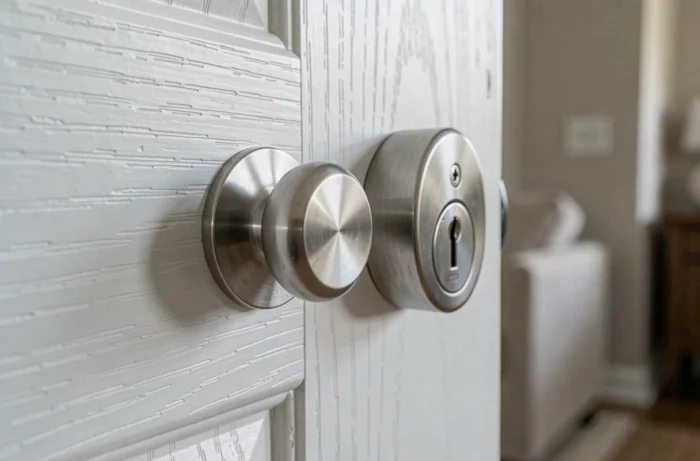
The lock remains the oldest and most widespread closing mechanism on secondary doors, garages, or internal access points. Between the button model, which can be operated with a simple thumb gesture, and the key lock, which requires a cylinder for each locking, the choice seems trivial. It is rarely so once we examine the consequences on resistance to burglary, insurance coverage, and the coherence of the door set.
A2P Certification and Home Insurance: The Criterion That Lock Type Alone Does Not Resolve
Since 2023-2024, an increasing number of home insurance contracts condition theft coverage on the presence of a lock or door set certified A2P on the main door. This requirement, previously reserved for high-risk homes or premium plans, is becoming standard for regular residences.
A lock, whether button or key, does not constitute a certified A2P device on its own. The certification applies to a whole: the cylinder, the housing, the bolt, and sometimes the complete door set. Installing a high-end key lock on a door whose main lock is not certified will not be sufficient to meet the contract conditions.
Before choosing between button and key, it is essential to check what the insurer actually requires. A button lock installed in addition to an A2P lock remains acceptable for most contracts because the overall security level of the access point is already achieved.
On the other hand, a key lock installed on a door without a certified lock does not fill the gap. Understanding the different types of key locks helps to properly size the device according to the cylinder and the desired certification level.
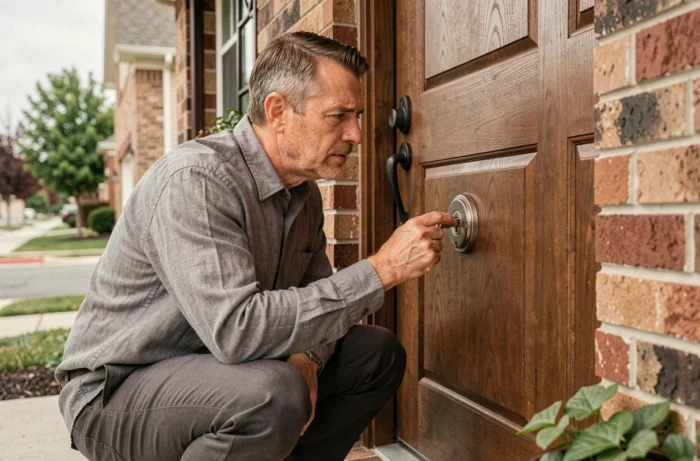
Button Lock or Key Lock: Real Resistance Against a Burglary Attempt
The button lock is operated from the inside without a key. A rotary or push button activates the bolt in the strike plate. On the outside, a cylinder allows unlocking with a key. This asymmetrical operation is suitable for doors that are primarily locked when one is present in the home: front door at night, bedroom door, internal access.
The double-entry lock (key on both sides) requires a cylinder on each face. It is intended for doors that need to be secured from both the inside and the outside, such as a garage door communicating with the house or a service door leading to a garden.
What Determines Resistance Is Not the Button
Resistance to burglary depends on three combined elements, not the method of internal operation:
- The cylinder: its length, type (European, round), and its protection against picking, bumping, or pulling. A low-quality cylinder negates the benefit of a key lock.
- The bolt: a short or soft steel bolt can be easily sheared or pushed back. The section and travel of the bolt in the strike plate matter more than the actuation system.
- The strike plate and fixing: a lock screwed into a fragile frame or with screws that are too short will give way under a crowbar, regardless of the mechanism.
A button lock equipped with a robust cylinder and a good section steel bolt offers resistance comparable to a low-end double-entry lock. The method of internal actuation is not an indicator of security.
EN 12209 Standard and Door Set Approach: The Technical Framework to Know
The European standard EN 12209 classifies mechanical locks and bolts according to their resistance, durability, and intensity of use. It serves as a reference for sizing the appropriate type of closure for each building. Standards EN 1627 to 1630, applied notably in Switzerland since January 2022, go further by imposing a “complete door” approach with classes RC1 to RC6 corresponding to measured resistance times.
This door set logic changes the way a lock is evaluated. A double-entry key lock classified according to EN 12209 in a high-resistance category loses all its benefit if installed on a thin particle board leaf or a non-reinforced frame. Conversely, a button lock integrated into a certified RC2 or RC3 door set contributes to a coherent whole whose overall resistance is tested in the laboratory.
Field feedback varies on this point: some installers systematically recommend the double cylinder for service doors, while others prefer the button lock to facilitate evacuation in case of emergency. The standard does not favor button over key; it evaluates the performance of the whole.
Everyday Security and Emergency Evacuation: A Often Overlooked Trade-off
The double-entry lock poses a concrete problem in an emergency situation. If the key is not on the interior cylinder, the occupant cannot quickly open the door. In a fire or gas leak, those seconds lost searching for a key can have serious consequences.
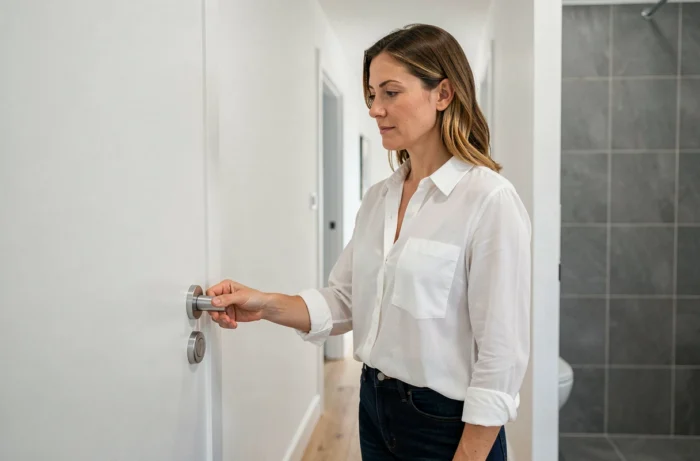
The button lock eliminates this risk. A single gesture is enough to release the bolt from the inside, even in darkness or under stress. For a front door used as an emergency exit, or for a home occupied by elderly people or children, the interior button is a broad safety choice, not just anti-burglary.
The double cylinder remains relevant on glazed or semi-glazed doors. An intruder can break the glass and operate a button from the outside. With an interior cylinder, they also need the key. This specific scenario justifies the double-sided key lock, provided the key is kept accessible (but not visible) nearby.
Which Lock for Which Use: Decision Grid by Door Type
| Type of Door | Recommended Lock | Main Reason |
|---|---|---|
| Main Entrance (solid) | Button + cylinder | Quick evacuation, complement to A2P lock |
| Glazed or semi-glazed entrance | Double cylinder | Prevents opening by breaking glass |
| Communicating garage door | Double cylinder | Locking from both sides |
| Exterior service door | Double cylinder | Infrequent access, enhanced security |
| Interior door (office, bedroom) | Simple button | Privacy, no need for a key |
This table provides a framework, but each situation requires checking the quality of the cylinder, the strength of the frame, and the coherence with the main lock. A well-chosen lock integrates into a global device, not in an isolated decision between button and key.