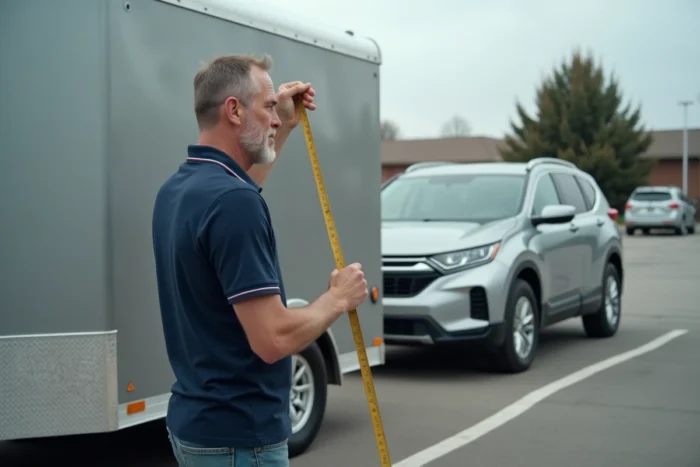
French regulations set precise length limits for trailers and towed units. These dimensions, outlined in the Highway Code, determine the right to circulate on public roads and specify the mandatory equipment to be carried.
Overhanging load at the rear: the rule most drivers ignore
Before even discussing the length of the trailer itself, an often-overlooked constraint deserves attention. Article R312-21 of the Highway Code states that the load must not exceed more than 3 meters from the rear end of the vehicle or its trailer.
In practice, this rule directly concerns the transport of long loads: beams, kayaks, surfboards, masts, or boat hulls. Even if the trailer complies with regulatory dimensions, a load that overhangs more than 3 m at the rear constitutes a separate offense.
This point should be systematically checked before hitting the road, as it adds to the overall limits of the unit. To understand in detail the maximum length of a trailer, one must therefore reason in two parts: the dimension of the chassis on one side, and the overhang of the load on the other.

Maximum length of a single trailer and the combination of towing vehicle plus trailer
The Highway Code sets two distinct limits that should not be confused.
- Single trailer: maximum 12 meters. This value corresponds to the overall length of the trailer, including the drawbar, excluding the towing vehicle.
- Combination of towing vehicle + trailer: maximum 18 meters. This is the distance measured from the front of the towing vehicle to the rear end of the trailer (including the load if it overhangs).
- For combinations specialized in transporting vehicles (car carriers), an exemption raises this limit to 20.35 meters, according to Article R312-21.
These thresholds apply to circulation on roads open to the public. An overhang, even by a few centimeters, shifts the entire unit into the category of exceptional transports, subject to prior prefectural authorization (Article R433-1 of the Highway Code).
Width and height: other dimensions to respect
Length is not the only dimensional criterion. The maximum allowed width for a trailer is set at 2.55 meters. The height, including the load, must not exceed 4 meters. These three dimensions form an enveloping volume that the driver must check before each trip.
GVW and GTW: when weight complements dimension
The legal length alone does not guarantee compliance. The maximum authorized weight in service (GVW) of the trailer and the maximum authorized weight in motion (GTW) of the combination come into play simultaneously.
The GVW is listed on the trailer’s registration document. It represents the maximum mass that the trailer can reach when loaded. The GTW, noted on the registration document of the towing vehicle, sets the maximum mass of the complete hitch (vehicle + trailer + load).
A combination can comply with the 18 m length while exceeding the GTW of the towing vehicle. This situation is illegal and dangerous: it significantly increases braking distances and alters the dynamic behavior of the hitch.
Required license according to the weight of the trailer
License B allows driving with a trailer whose GVW does not exceed 750 kg. Beyond that, driving remains possible under license B provided that the sum of the GVWs (vehicle + trailer) does not exceed 3,500 kg and that the GVW of the trailer remains less than the unladen weight of the towing vehicle.
When the sum of the GVWs is between 3,500 and 4,250 kg, the additional mention 96 on license B becomes mandatory. Beyond 4,250 kg, only license BE allows legal circulation.
Registration and lighting: obligations related to long trailers
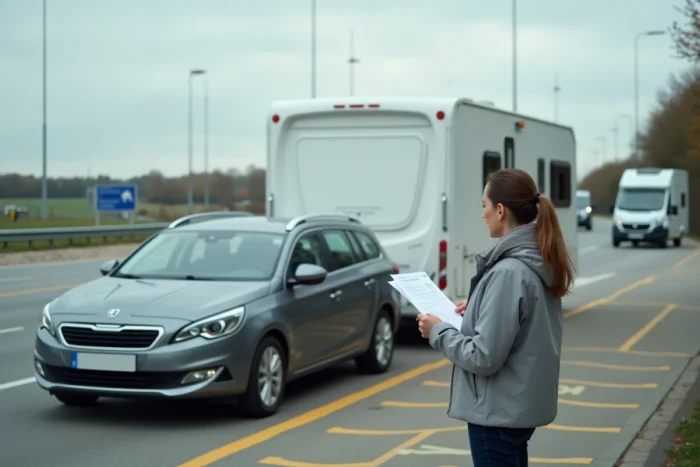
Any trailer with a GVW exceeding 500 kg must have its own registration document and license plate. Lighter trailers are exempt but must display the license plate of the towing vehicle.
Lighting is a frequent control point. Regulations require position lights, turn signals, brake lights, and reflectors at the rear. For trailers wider than 1.60 m, side marker lights are also required. On long combinations, these side lights become essential for night visibility.
Signaling of load overhang
When the load exceeds the rear end of the trailer (within the limit of the authorized 3 m), a signaling device is mandatory. During the day, a square sign with red and white stripes must be affixed to the end of the load. At night or in reduced visibility, a red light and a red reflector complete this device.
Maximum speed allowed with a trailer on highways and roads
Speed limits change as soon as a vehicle tows a trailer. On highways, the speed is capped at 110 km/h when the GTW remains less than or equal to 3.5 tons. Beyond this threshold, the limit drops to 90 km/h.
On national and departmental roads, the maximum speed is 80 km/h for any vehicle towing a trailer whose GVW exceeds 750 kg. These limitations apply even if local signage permits a higher speed for unhitched vehicles.
A long and heavy combination traveling at an inappropriate speed accumulates risks: trailer whip effect, instability in curves, multiplied braking distance. Adhering to these limits protects both the driver and other road users.
The compliance of a hitch relies on a set of intersecting criteria: trailer length, total length of the combination, load overhang, weight, license, lighting, and speed. Checking each of these points before departure remains the only reliable method to avoid vehicle immobilization or a fine on the roadside.