
A newborn does not require a sophisticated program. It needs safe sleep, age-appropriate nutrition, regular hygiene care, and human presence. Taking good care of your baby on a daily basis relies on mastering these fundamentals, applied with consistency rather than perfection.
Sleeping safety: the strict rules to know
Sleep occupies the largest part of a newborn’s day. The way the bed is prepared directly affects its safety. The French Ministry of Health emphasizes a clear guideline: no objects in the baby’s bed, including bumper pads, baby wedges, nests, pillows, blankets, or stuffed animals.
The baby should be laid on its back, flat, in a crib equipped with a firm mattress. Only a sleep sack appropriate for its size is allowed. These precautions aim to reduce the risk of sudden infant death syndrome, a topic on which recommendations have strengthened in recent years.
To find baby advice on Je Suis Maman, which also details sleep milestones month by month, this strict sleeping arrangement is the foundation of any reliable nighttime routine.
Two additional guidelines help structure the nights:
- Keep the room between 18 and 20 °C, without extra bedding, even in winter.
- Favor darkness and quiet for nighttime feedings, to avoid stimulating wakefulness.
- Respect the baby’s spontaneous sleepiness rather than waking it to follow a theoretical schedule.

First bath and skin care for the newborn
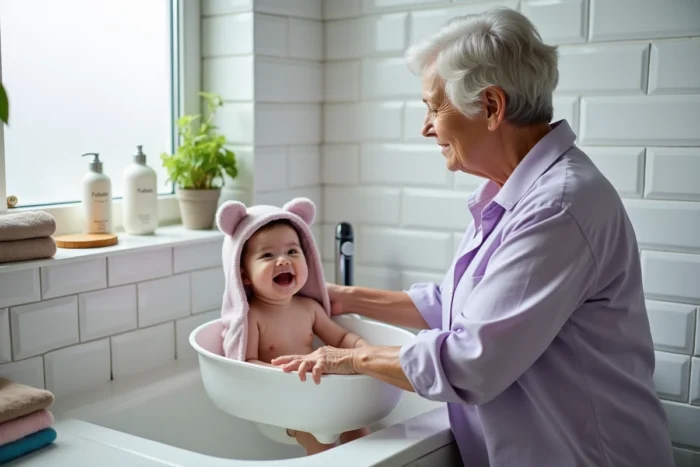
Baby hygiene is not limited to the frequency of baths. The current trend, supported by the WHO and many pediatricians, is to delay the first bath by at least 24 hours after birth. The vernix, this whitish substance present on the newborn’s skin, plays a protective role and promotes thermal stability.
Once the first few days have passed, a bath every two to three days is sufficient for a newborn that does not get dirty. The areas that require daily cleaning are the face, neck (where milk can accumulate in the folds), hands, and diaper area.
Hygiene products: less is more
A baby’s skin is thinner and more permeable than that of an adult. A fragrance-free superfat soap covers most needs. Scented wipes, lotions, and toilet waters add unnecessary, even irritating substances. Oleocalcareous liniment remains a reliable choice for diaper changes, as it cleans and protects in one application.
After the bath, thoroughly dry each fold (neck, armpits, behind the ears, groin) to prevent irritations and fungal infections, which are common in newborns.
Baby nutrition: rhythm and hunger signals
Whether breastfeeding or using infant formula, the principle remains the same during the first months: feed the baby on demand. The notion of “every three hours” is a statistical guideline, not an absolute rule. Some newborns request feedings every two hours, while others can go four hours without difficulty.
The hunger signals always precede crying: the baby turns its head, opens its mouth, brings its hands to its face. Waiting for crying means the signal has been missed, making breastfeeding or bottle-feeding more difficult, as the baby is then agitated.
Guidelines for introducing solid foods
Diversification generally begins between four and six months, according to the pediatrician’s recommendations. Introduction is done one food at a time, in small quantities, to detect any potential allergic reactions.
- Start with cooked and pureed vegetables (carrot, zucchini, green beans), introducing one new vegetable per week.
- Introduce cooked fruits after a few weeks of vegetables, to prevent the sweet taste from creating a rejection of neutral flavors.
- Do not add salt, sugar, or honey before the age of one (honey poses a risk of infant botulism).
- Continue breastfeeding or bottle-feeding in parallel, as milk remains the main food during the first year.
Awakening and development: what really matters
A baby does not need sophisticated toys to develop. During the first weeks, the human face is the most powerful stimulus. Talking to the baby, looking at it, responding to its coos builds the foundation of communication.
Time spent on the tummy (under supervision, on a firm mat) strengthens neck and back muscles, preparing for rolling over and crawling. A few minutes a day is sufficient at first, gradually increasing according to the baby’s tolerance.
Screens and overstimulation
Pediatric societies recommend complete absence of screens before the age of two, including television as background noise. Passive exposure to screens disrupts attention and delays language acquisition. A calm environment, with direct verbal exchanges, provides a much more favorable setting for cognitive development.
The quality of presence matters more than the quantity of stimulation. A baby observing an adult folding laundry while talking to them learns as much as with a musical mobile above their crib.
Taking care of a baby on a daily basis does not require medical expertise or expensive equipment. Safe sleeping, clean and protected skin, nutrition guided by the baby’s signals, and attentive presence form a sufficient framework. The rest, such as stabilizing schedules, lengthening nights, and emerging smiles, follows its own rhythm.